
Chapter 2
Contents
- 2.1 Why Time? (Not Human Nature, Scarcity, or Power)
- 2.1.1 Why Not Human Nature?
- 2.1.2 Why Not Scarcity?
- 2.1.3 Why Not Power?
- 2.1.4 Time as Generative Structure
- 2.2 The Fundamental Question
- 2.2.1 Two Possible Stances
- 2.2.2 Why This Question Is Fundamental
- 2.2.3 Objections Addressed
- 2.2.4 The Question Made Concrete
- 2.3 Two Ontological Stances
- 2.3.1 Endpoint-Belief: The Logic of Temporal Arrest
- 2.3.2 No-Endpoint Commitment: The Logic of Perpetual Evolution
- 2.3.3 The Ontological Divide
- 2.3.4 Most Reality Mixes Elements
- 2.4 Generativity: From Ontology to Politics
- 2.4.1 Epistemological Responses
- 2.4.2 Ethical Responses
- 2.4.3 Institutional Design Responses
- 2.4.4 Social Coordination Responses
- 2.4.5 The Systematic Pattern
- 2.5 Time in Political Practice
- 2.5.1 Revolutionary Temporality
- 2.5.2 Conservative Temporality
- 2.5.3 Temporal Arguments in Contemporary Politics
- 2.5.4 Temporal Rhetoric Reveals Ontological Commitments
- 2.5.5 Time Isn’t Arbitrary Imposition
- 2.6 Scope and Limitations
- 2.6.1 What This Framework Explains Well
- 2.6.2 What This Framework Doesn’t Fully Explain
- 2.6.3 The Framework’s Specific Contribution
- 2.6.4 Relationship to Other Causal Levels
- 2.6.5 Theoretical Honesty
- Conclusion
Time as Criterion
Chapter 1 revealed a puzzle. Traditional political criteria—economic policy, attitude toward change, equality versus hierarchy, liberty versus authority, nationalism versus internationalism—systematically create confusion. They catalog surface phenomena without explaining deeper patterns. They describe tools without probing purposes, policies without examining premises.
The Nazi case illustrated this. National Socialism’s economic interventionism suggests “left,” yet we classify it “far-right.” Soviet communism and Nazi fascism converged toward identical structures despite opposite ideological contents. Edmund Burke and Friedrich Hayek aligned despite different starting points. Traditional criteria cannot explain these patterns.
What would a valid criterion require? It must reach beneath surface policies to fundamental premises. It must explain both clustering (why certain positions systematically associate) and convergence (why different ideologies produce similar structures). It must reveal causation, not merely correlation.
But which criterion? What fundamental question precedes all political choices?
This chapter proposes: time.
More precisely: assumptions about historical endpoints. Does history move toward a knowable, achievable perfect state? Or does it evolve perpetually without terminus?
This temporal question generates political structures. Not directly—time assumptions don’t mechanically determine all political choices. But they structure responses to every other political variable. They function as grammar functions in language: organizing meaning from vocabulary.
The chapter proceeds in six sections:
Section 2.1 addresses a natural objection: Why privilege time? Why not human nature, scarcity, or power as foundational variables? The answer: time assumptions are not “more important” but “more generative”—they structure responses to all other variables.
Section 2.2 establishes the fundamental temporal question: Does history have an endpoint? This question is ontological, not empirical. It shapes how we understand existence itself.
Section 2.3 presents two ontological stances: endpoint-belief and no-endpoint commitment. These aren’t empirical predictions but metaphysical frameworks structuring political thought.
Section 2.4 demonstrates generativity: how time assumptions systematically shape responses across political domains—epistemology, ethics, institutional design, social coordination.
Section 2.5 shows that time is not arbitrary imposition but emerges from political practice. Historical actors invoke temporal justifications for their positions.
Section 2.6 acknowledges scope: time assumptions don’t explain everything. But they explain systematic patterns that traditional criteria cannot.
The chapter makes an analytical claim, not a normative one. Whether endpoint-belief or no-endpoint commitment is preferable remains open. This chapter only argues: temporal assumptions structure politics in ways traditional criteria miss.
2.1 Why Time? (Not Human Nature, Scarcity, or Power)
Every political theory claims a foundational variable. Hobbes privileges human nature. Economics privileges scarcity. Realists privilege power. Why should time assumptions be considered foundational?
The answer requires precision. I do not claim time is “more important” than human nature, scarcity, or power. These variables matter profoundly. Rather, I claim time assumptions are “more generative”—they structure how political actors respond to all other variables.
An analogy clarifies. In geometry, space and points are important. But axioms are generative—they determine how space and points relate, how theorems derive, what can be proven. Similarly, in politics, human nature, scarcity, and power are important variables. But time assumptions are generative structures—they determine how political actors respond to human nature, approach scarcity, organize power.
This section examines three prominent candidates for foundational status—human nature, scarcity, power—and shows why time assumptions are more generative than any of them.
2.1.1 Why Not Human Nature?
Human nature theories claim politics reflects permanent features of human psychology. Hobbes argues humans are selfish; Rousseau argues they’re cooperative; Madison argues they’re mixed. Evolutionary psychology identifies inherited behavioral patterns. These approaches share a premise: human nature is constant, and politics must accommodate it.
But this premise creates a puzzle: if human nature is constant, why do political systems vary so dramatically?
Ancient Athens and Sparta shared the same human genetic inheritance. Yet Athens developed democracy; Sparta developed militaristic oligarchy. Modern America and modern China share the same human species. Yet their political systems differ fundamentally. If human nature determines politics, why this variation?
The answer: human nature provides background conditions, but time assumptions determine responses.
Consider how different time assumptions generate opposite political strategies from the same view of human nature:
Blueprint response to human nature:
Endpoint-belief treats current human nature as corrupted or imperfect but perfectible. The endpoint is “New Man”—transformed human psychology matching the ideal state.
The Soviet project aimed to create “New Socialist Man,” eliminating bourgeois selfishness through collective ownership and revolutionary education. Nazi ideology sought racial purification, believing Aryan nature could be cultivated by eliminating corruption. Maoist campaigns targeted “feudal consciousness,” attempting to create revolutionary psychology through struggle sessions and reeducation.
All share a temporal logic: current human nature deviates from potential human nature. The endpoint is human transformation. Politics must force this transformation.
Principle response to human nature:
No-endpoint commitment treats human nature as permanent. Humans will always exhibit selfishness, cooperation, irrationality, creativity—a complex mixture resistant to systematic improvement. Politics cannot perfect human nature; it must work within permanent constraints.
James Madison: “If men were angels, no government would be necessary.” The Constitution’s separation of powers assumes permanent human flaws—ambition, factionalism, power-seeking. Instead of trying to eliminate these tendencies, the system channels them toward mutual checking. Markets assume permanent self-interest and coordinate it through prices rather than trying to transform it through education.
The crucial difference: Same acknowledgment that humans are flawed. Opposite conclusions about what to do.
Blueprint assumes malleability toward perfection. Principle assumes permanence requiring accommodation. This difference reflects time assumptions: endpoint-belief generates transformation projects; no-endpoint commitment generates institutional constraints.
Human nature provides the raw material. Time assumptions determine the response. Human nature is background; time is generative.
2.1.2 Why Not Scarcity?
Economic theories often privilege scarcity as foundational. Resources are limited; wants exceed means; politics allocates scarce goods. This appears foundational—absent scarcity, many political conflicts disappear.
But scarcity doesn’t determine political choice. The crucial question is: Can scarcity be transcended?
Different time assumptions generate systematically different answers:
Blueprint response to scarcity:
If history has an endpoint, that endpoint might include abundance. Technology advances, productivity increases, organization improves. Eventually, scarcity could be eliminated.
Soviet ideology promised: “From each according to his ability, to each according to his need.” This presumes eventual abundance—scarcity is temporary obstacle to be overcome through planning and industrialization. Reaching the endpoint requires reorganizing production, eliminating market waste, coordinating resources centrally.
Modern techno-utopianism repeats this logic. Automation will eliminate labor scarcity. Artificial intelligence will solve coordination problems. Post-scarcity economics becomes possible. Political conflicts over distribution will end.
The temporal assumption: scarcity is historical, not permanent. The endpoint transcends it. Politics must reorganize society to reach abundance.
Principle response to scarcity:
If history has no endpoint, scarcity is perpetual. Technology doesn’t eliminate scarcity; it shifts scarcity to new domains. When food becomes abundant, attention becomes scarce. When material goods proliferate, time becomes scarce. New wants emerge faster than means expand.
Therefore, politics cannot transcend scarcity—it must manage scarcity continuously. Markets coordinate through prices, signaling relative scarcity, adjusting production and consumption. No central plan can solve scarcity permanently because conditions perpetually change.
The temporal assumption: scarcity is ontological, not historical. No endpoint eliminates it. Politics must enable adaptive coordination, not pursue abundance.
Same economic reality, opposite political implications:
Blueprint: Reorganize to transcend scarcity → centralize planning
Principle: Accept perpetual scarcity → enable market coordination
This difference doesn’t stem from scarcity itself—both acknowledge resource limits. The difference stems from temporal assumptions about whether scarcity can be transcended.
Scarcity is constant background. Time assumptions are generative structure.
2.1.3 Why Not Power?
Power appears fundamental to politics. All political systems involve power—the capacity to compel, coordinate, enforce. Realist theories make power the central variable: politics is struggle for power; power determines outcomes.
But power is a resource or tool. The question is: Power for what purpose?
Time assumptions structure the answer:
Blueprint use of power:
Endpoint-belief requires overwhelming centralized power. Why?
Current reality deviates from the ideal endpoint. The gap must be closed. But society resists transformation—vested interests, cultural inertia, ideological confusion obstruct progress toward the endpoint. Resistance must be overcome.
Moreover, reaching the endpoint requires comprehensive coordination. Partial change is insufficient—the whole society must transform synchronously. Otherwise, unchanged sectors contaminate transformed sectors, pulling the system back toward deviation.
Therefore: centralize power, eliminate competing power centers, coordinate transformation from single authority. Power serves the endpoint.
This explains why diverse endpoint ideologies—Soviet communism, Nazi fascism, Jacobin republicanism, Maoist revolution—converge toward similar power structures. Different endpoint contents, identical structural implications: centralization, elimination of intermediaries, total mobilization.
Principle use of power:
No-endpoint commitment requires distributed, limited power. Why?
If no perfect state exists to force, no single authority should monopolize power. Knowledge is too dispersed, conditions too variable, future too uncertain for central control. Evolution requires experimentation, which requires autonomy, which requires distributed authority.
Moreover, power itself corrupts—concentrating power invites abuse. Since no endpoint justifies unlimited means, power must be constrained regardless of goals. Separation of powers, federalism, checks and balances protect against power accumulation.
Therefore: distribute power across institutions, maintain competing centers, limit each authority’s scope. Power serves process protection, not goal achievement.
Same resource (power), opposite organizational logics:
Blueprint: Centralize power to force transformation
Principle: Distribute power to enable evolution
The difference doesn’t stem from power itself—both systems employ power. The difference stems from temporal assumptions about whether there exists a perfect state worth forcing.
Power is universal tool. Time assumptions are generative structure determining how power is organized.
2.1.4 Time as Generative Structure
Human nature, scarcity, and power are important variables. But they are constants or resources, not generating structures.
Time assumptions, by contrast, structure responses to all other variables:
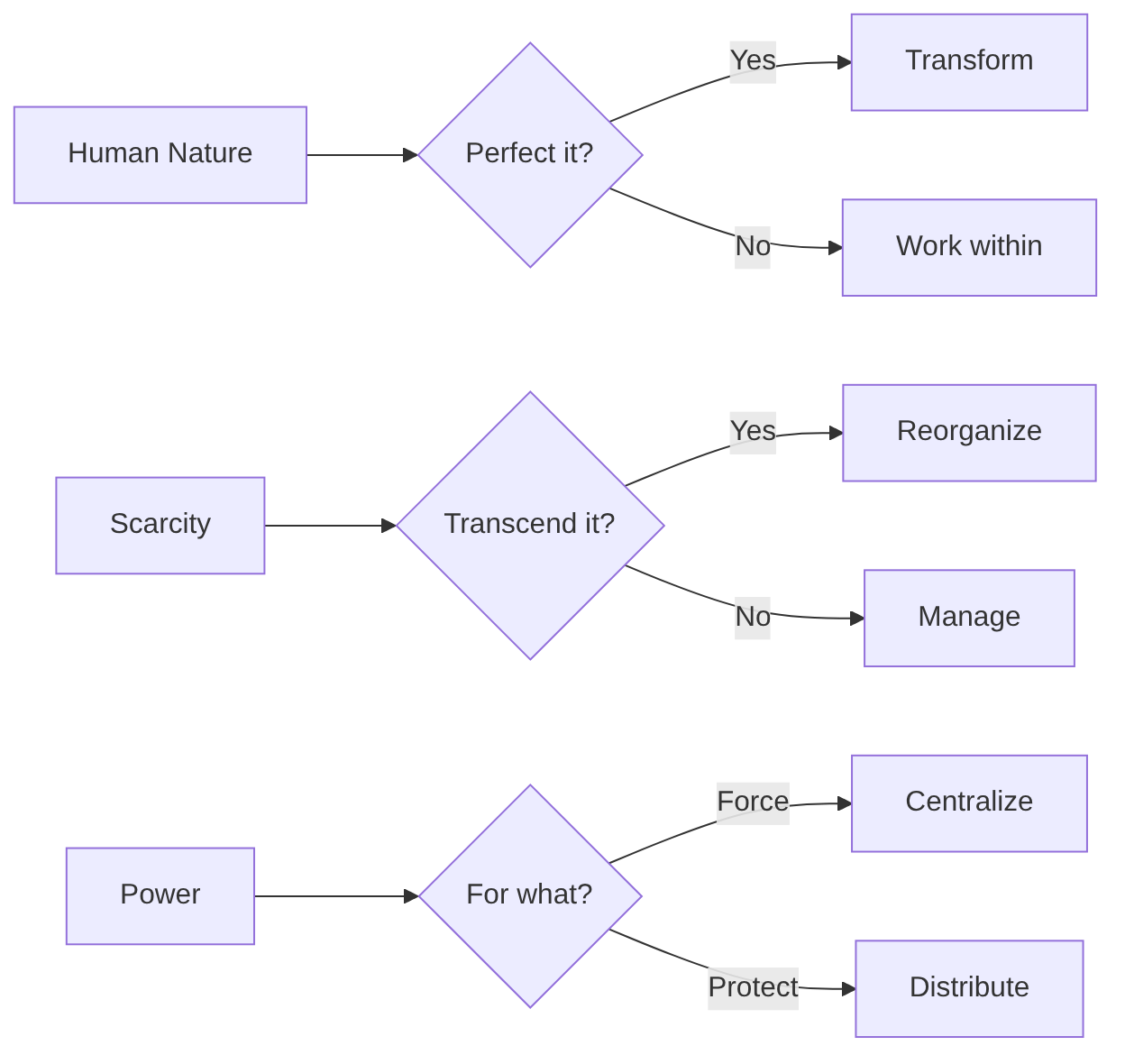
This pattern repeats across political domains. Time assumptions don’t replace other variables—they organize responses to them.
An analogy: grammar and vocabulary.
Vocabulary provides words—the raw material of language. Grammar provides rules for combining words—the structure generating meaning. You can’t have language with only vocabulary (random words communicate nothing) or only grammar (structure without content is empty). Both are necessary. But grammar is generative—it determines how vocabulary creates meaning.
Similarly, human nature, scarcity, and power provide political “vocabulary”—background realities all political systems confront. Time assumptions provide political “grammar”—structures determining how these realities generate political responses.
Grammar doesn’t make vocabulary unimportant. Time assumptions don’t make human nature, scarcity, or power unimportant. But grammar generates meaning from vocabulary. Time assumptions generate politics from other variables.
Why this matters:
Political theorists often debate: Is human nature or material conditions more fundamental? Is power or culture more important? These debates presume we must choose among variables.
But the framework proposed here suggests a different structure. Other variables matter profoundly—they provide constraints and resources. But time assumptions are generative—they structure how political actors interpret and respond to those constraints and resources.
This doesn’t mean time assumptions are “truer” or “better” than other variables. It means they operate at a different level. They are not additional content alongside human nature, scarcity, and power. They are organizing structures determining what political actors do with human nature, scarcity, and power.
The fundamental temporal question:
If time assumptions are generative, what temporal question structures politics?
Not: How much time do we have? (empirical)
Not: What is time’s nature? (metaphysical)
But: Does history have an endpoint?
This question precedes specific policy debates. It structures how political actors understand existence itself, interpret social reality, justify political action.
The next section establishes this question as fundamental.
2.2 The Fundamental Question
Political conflicts appear to concern specific policies: tax rates, regulation levels, welfare spending, foreign intervention. But beneath policy debates lies a deeper question, rarely articulated explicitly yet structuring all political reasoning:
Does history move toward a knowable, achievable perfect state where essential change should cease?
This is not an empirical question. It cannot be answered by examining historical data or predicting future trends. It is an ontological question—a question about the fundamental nature of existence and time.
Yet this abstract question generates concrete political divisions. How?
2.2.1 Two Possible Stances
Every political actor, consciously or unconsciously, takes one of two stances:
Stance 1: Endpoint-Belief
History moves toward a knowable, achievable endpoint—a perfect or ideal state where essential change should cease. This endpoint might be communist (classless society, stateless abundance), Nazi (racially pure Aryan Volksgemeinschaft), Jacobin (rational republic based on Enlightenment reason), Islamic fundamentalist (restored Caliphate under Sharia law), techno-utopian (post-scarcity automated abundance), or progressive (perfected social justice and equality).
The specific content varies radically. But the structure is identical: history has direction and destination. The endpoint is knowable (we can specify its features). The endpoint is achievable (we can reach it through political action). Once reached, essential change should cease (the endpoint is stable perfection).
Stance 2: No-Endpoint Commitment
History has no endpoint. Society evolves perpetually. The concept of “perfect state” is ontologically mistaken. This doesn’t mean “nothing improves” or “all states are equally good.” It means no final state exists where essential change should stop.
Why no endpoint? Three interconnected commitments:
Epistemic: Society is too complex, knowledge too dispersed, for any person or group to design perfection. We cannot know what perfection would be.
Temporal: Conditions perpetually change. What works in one context fails in another. No stable endpoint is possible because circumstances never stabilize.
Ontological: Time’s flow is constitutive of existence. Attempting temporal arrest violates reality’s nature. The endpoint concept itself is incoherent.
These aren’t empirical predictions (endpoints haven’t been reached yet). They’re metaphysical commitments (endpoints cannot exist).
2.2.2 Why This Question Is Fundamental
Why should we consider this temporal question more fundamental than traditional political criteria?
First: It precedes policy debates
Tax policy, welfare spending, market regulation—these are means debates. The temporal question concerns ends.
If you believe history has an endpoint, every policy becomes instrumental: Does this advance or retard progress toward the endpoint? If you deny endpoints exist, every policy becomes provisional: Does this enable adaptive evolution or rigidify structures?
The policy is the same (e.g., progressive taxation). The justification differs fundamentally based on temporal assumptions.
Second: It explains clustering
Why do certain positions systematically associate? Why does support for centralized planning correlate with support for teleological ethics, which correlates with support for comprehensive transformation?
Traditional criteria cannot explain this. Economic interventionism doesn’t logically require moral consequentialism. But endpoint-belief systematically generates both: if history has a perfect destination, then (1) society must be comprehensively reorganized to reach it (planning), and (2) means are justified by ends (teleology).
The temporal question explains clustering that traditional criteria treat as mere correlation.
Third: It explains convergence despite content differences
Why did Soviet communism and Nazi fascism—opposite ideological contents—produce nearly identical political structures?
Content answer: Both were totalitarian. (But this just relabels the puzzle—why did opposite ideologies generate same totalitarianism?)
Temporal answer: Both believed history has endpoints (classless society vs. racial purity). Both attempted temporal arrest at their respective endpoints. Both faced identical structural implications: current reality deviates from endpoint → must force transformation → must centralize power → must eliminate resistance → must destroy intermediaries → must synchronize change.
Different contents, identical temporal structure, identical political outcomes.
Fourth: It operates across historical periods and cultural contexts
The temporal question isn’t culturally specific or historically contingent. It appears in:
Ancient philosophy: Plato’s Forms vs. Aristotle’s perpetual motion, Medieval theology: Joachim’s Third Age vs. Aquinas’s incomplete creation, Modern ideology: Marxist historical materialism vs. Burkean organic evolution, and Contemporary politics: Progressive teleology vs. conservative gradualism.
The specific formulations change. The underlying temporal divide persists.
Fifth: It structures responses to all other variables
Section 2.1 showed this for human nature, scarcity, and power. The pattern continues across domains:
Knowledge: Can truth be finally known (endpoint) or is inquiry perpetual (no endpoint)?
Ethics: Can perfect morality be specified (endpoint) or does moral understanding evolve (no endpoint)?
Social change: Should transformation be comprehensive (endpoint) or incremental (no endpoint)?
Every major political question ramifies from temporal assumptions.
2.2.3 Objections Addressed
Objection 1: “This is just progressivism versus conservatism”
No. Traditional progressive-conservative distinction concerns attitude toward change. The temporal question concerns assumptions about historical structure.
Many progressives reject endpoints—they favor continuous reform without claiming history reaches perfection. Some conservatives believe in endpoints—reactionaries seek return to golden age (past endpoint) or religious conservatives await divine kingdom (future endpoint).
The temporal question cuts across traditional categories. Chapter 8 will map the relationships precisely.
Objection 2: “Nobody actually believes history ends”
This misunderstands the claim. Endpoint-belief doesn’t require believing “history literally stops.” It means believing essential change should cease once the ideal state is achieved.
Soviet ideology didn’t claim time would stop in communist society. It claimed class conflict—the driver of historical change—would end. No further revolutionary transformation needed. Society would manage resources, but fundamental structure would be perfected.
The endpoint is normative-structural, not temporal-physical.
Objection 3: “This makes everything about time”
No. The claim is not that time causes everything but that time assumptions structure responses to everything.
Human nature, material conditions, cultural patterns, institutional designs all matter. The framework doesn’t reduce politics to time. It argues time assumptions organize how political actors interpret and respond to these other factors.
Analogy: Grammar doesn’t reduce language to rules. Grammar structures how vocabulary creates meaning. Similarly, time structures how variables create politics.
Objection 4: “People don’t think about historical endpoints”
True. Most political actors don’t explicitly theorize about time and history. But they make temporal assumptions implicitly:
When revolutionaries claim “history is on our side,” they assume directional time toward their endpoint, When incrementalists say “we can’t engineer society,” they assume no blueprint exists, When activists demand “comprehensive transformation,” they assume current reality fundamentally deviates from knowable ideal, and When traditionalists defend “organic development,” they assume no perfect state justifies forcing change.
The temporal question operates implicitly in political reasoning even when not explicitly articulated.
2.2.4 The Question Made Concrete
Abstract philosophy becomes concrete politics. Consider three scenarios:
Scenario 1: Economic Crisis
Recession hits. Unemployment rises. Suffering spreads.
Endpoint-belief response: This crisis reveals capitalism’s contradictions. The system must be comprehensively reorganized according to rational plan. Incremental reforms are inadequate—fundamental transformation is required. The crisis creates opportunity to accelerate progress toward the endpoint (socialist/technocratic/egalitarian society).
No-endpoint response: This crisis reflects temporary economic imbalance. The system needs correction, not transformation. Adaptive adjustments through market mechanisms, policy tweaks, institutional reforms. No perfect system exists—we manage problems as they emerge.
Same crisis. Opposite diagnoses. Different temporal assumptions.
Scenario 2: Social Inequality
Wealth concentrates. Gaps widen. Injustice persists.
Endpoint-belief response: This inequality reflects unjust system. The solution is creating just society—specifiable, achievable through redistribution, regulation, transformation of property relations. We know what justice requires; we must implement it comprehensively.
No-endpoint response: This inequality reflects complex factors—technology, globalization, policy, culture. No perfect equality exists; trade-offs are inescapable. We address specific problems through specific reforms, accepting that new issues will emerge, requiring continuous adaptation.
Same facts. Opposite frameworks. Different temporal assumptions.
Scenario 3: Cultural Conflict
Values clash. Groups polarize. Unity fractures.
Endpoint-belief response: This conflict reflects imperfect consciousness. The solution is education, transformation, creating unified culture around correct values. Diversity is temporary obstacle; the endpoint is harmonious consensus.
No-endpoint response: This conflict reflects permanent pluralism. Values will always differ; unity comes through process (toleration, dialogue, institutions managing disagreement), not consensus. We protect conditions for coexistence, not pursue unified culture.
Same situation. Opposite strategies. Different temporal assumptions.
These aren’t merely different policies. They’re different ontologies—different understandings of what kind of entity society is, what kind of process history is, what politics can achieve.
The fundamental temporal question structures everything downstream.
2.3 Two Ontological Stances
The previous section established that a fundamental temporal question structures politics: Does history have an endpoint? This section develops the two possible answers into full ontological stances.
These stances are not merely different beliefs about the future. They are comprehensive frameworks structuring how political actors understand existence, interpret reality, and justify action. Like Weberian ideal types, they represent pure logical structures. Most empirical political positions mix elements. But understanding the pure forms reveals underlying coherence.
2.3.1 Endpoint-Belief: The Logic of Temporal Arrest
Core premise: History moves toward a knowable, achievable perfect state where essential change should cease.
This premise generates a systematic ontological structure:
Epistemological implication: Truth is knowable
If a perfect endpoint exists, we can know its features. History reveals progressive truth, reason discerns ideal principles, science predicts optimal organization, or divine revelation specifies correct order. Different endpoint ideologies offer different knowledge sources. But all share the premise: we can know what perfection requires.
This isn’t naive certainty. Sophisticated endpoint theories acknowledge uncertainty about details. But they maintain: core features of the endpoint are knowable. We may debate implementation, but we know the destination.
Ontological implication: Current reality is deviation
If the endpoint is perfect and knowable, current reality deviates from it. Society is corrupted (from religious ideal), alienated (from species-being), irrational (from enlightenment principles), or unjust (from equality ideal).
This deviation is not merely imperfection requiring improvement. It is fundamental gap between reality and ideal—a gap that must be closed through transformation.
Temporal implication: Historical direction
If history moves toward an endpoint, time has direction. Past was worse, present is transitional, future will be better. Progress is possible and necessary. History is not circular repetition or random change—it’s directional movement toward the endpoint.
This doesn’t require inevitability. History might regress, stagnate, take wrong turns. But progress toward the endpoint is history’s telos—its purpose and proper direction.
Ethical implication: Teleological justification
If the endpoint is perfect and achievable, reaching it justifies means. Not crude “ends justify any means”—sophisticated endpoint theories maintain some constraints. But the endpoint’s supreme value relativizes competing moral claims.
Violence might be regrettable but necessary to overcome resistance. Individual rights might be important but secondary to collective transformation. Traditional morality might be respected but superseded by revolutionary ethics serving the endpoint.
The endpoint functions as ultimate moral standard against which all actions are measured.
Political implication: Comprehensive transformation required
If current reality fundamentally deviates from a knowable ideal, incremental reform is inadequate. The gap is too large, the deviation too deep, the system too corrupted for piecemeal fixes.
Politics must comprehensively reorganize society. Economic structures, social relations, cultural patterns, institutional arrangements—all must transform to match the endpoint’s requirements.
Partial change is insufficient and potentially counterproductive. Unchanged sectors might contaminate transformed sectors, pulling the system back toward deviation. Therefore: synchronized, comprehensive transformation across all domains simultaneously.
Structural Implications (when premises applied consistently):
The logic of endpoint-belief systematically generates structural tendencies:
Centralize power: Comprehensive transformation requires coordinated direction. Market spontaneity would generate deviation. Dispersed authority would create inconsistency. Therefore, centralize power to force synchronized change.
Plan comprehensively: Cannot allow economic spontaneity to undermine political goals. Must coordinate production, distribution, consumption according to endpoint requirements. Therefore, centralized planning replaces market coordination.
Eliminate intermediaries: Family, church, local community, voluntary association create alternative loyalties, preserve traditional patterns, resist transformation. They stand between individual and state, preventing direct mobilization. Therefore, destroy or subordinate intermediaries.
Enforce spatio-temporal synchronization: The endpoint requires uniformity—same organization, same values, same consciousness across all society simultaneously. Local variation creates deviation. Temporal lag allows resistance to consolidate. Therefore, enforce synchronized transformation across space and time.
Adopt teleological ethics: If the endpoint is supremely valuable and current reality fundamentally deviates, then achieving the endpoint justifies overriding traditional moral constraints. Temporary violence serves permanent peace. Short-term suffering serves long-term happiness. Therefore, consequentialist ethics measured against the endpoint.
These aren’t arbitrary associations. They flow systematically from endpoint-belief’s premises. Different endpoint contents (communist, fascist, theocratic, technocratic) produce these same structural tendencies because the logical structure is identical.
2.3.2 No-Endpoint Commitment: The Logic of Perpetual Evolution
Core premise: History has no endpoint. Society evolves perpetually. The concept of “perfect state” is ontologically mistaken.
This premise generates a systematically different ontological structure:
Epistemological implication: Knowledge is dispersed and incomplete
No person or group possesses knowledge sufficient to design social perfection. Knowledge is local, contextual, tacit—dispersed across millions of individuals responding to specific circumstances. No central authority can aggregate this knowledge. Moreover, we cannot know what future conditions will require.
This isn’t mere skepticism. It’s ontological claim: perfect social knowledge is impossible in principle, not just difficult in practice.
Ontological implication: Reality is complex process
Society isn’t entity approaching ideal form. It’s complex evolutionary process—continuous adaptation, experimentation, selection. No final state exists toward which this process aims. Process is all there is.
This doesn’t mean “anything goes” or “all states are equal.” Evolution produces better and worse adaptations. But “better” is contextual and provisional, not absolute and final.
Temporal implication: Time’s flow is constitutive of existence
Attempting temporal arrest violates reality’s nature. Time’s flow isn’t obstacle to overcome but condition of existence. Change isn’t deviation from stability—change is fundamental, stability is temporary.
This doesn’t mean “everything constantly changes.” Patterns persist, institutions stabilize, traditions endure. But their persistence reflects ongoing adaptation, not achievement of final form.
Ethical implication: Deontological constraints
If no perfect endpoint justifies unlimited means, ethics cannot be purely consequentialist. Some constraints must hold regardless of goals. Individual rights, procedural justice, moral rules protect against the temptation to sacrifice everything for ends.
This doesn’t mean absolute deontology. Sophisticated no-endpoint theories acknowledge that consequences matter. But they deny that any consequence—even utopia—justifies any means.
Principles constrain goals. Process matters independent of outcomes.
Political implication: Protect evolutionary processes
If society is evolutionary process without endpoint, politics must enable adaptation, not force transformation. This means:
Protect variation: Experimentation requires diversity. Different communities try different approaches. Uniformity prevents learning which approaches work.
Enable selection: Successes and failures must be identifiable. Market prices signal what works economically. Democratic feedback signals what works politically. Without selection mechanisms, evolution cannot occur.
Allow time: Adaptation is gradual. Forcing rapid change prevents learning, creates disruption, generates unintended consequences. Evolution requires patience.
Preserve intermediaries: Family, community, association provide sites for experimentation, preserve local knowledge, mediate between individual and state. They’re evolutionary infrastructure, not obstacles.
Structural Implications (when premises applied consistently):
No-endpoint commitment systematically generates different structural tendencies:
Distribute power: Knowledge is too dispersed for central planning. Conditions are too variable for uniform rules. Future is too uncertain for comprehensive control. Therefore, distribute power to enable local experimentation and adaptation.
Enable markets: Spontaneous coordination through prices aggregates dispersed knowledge, adapts to changing conditions, generates innovation. Central planning cannot replicate this. Therefore, rely on market mechanisms.
Protect intermediaries: Family, church, community, voluntary association preserve local knowledge, enable variation, mediate authority. They’re essential evolutionary infrastructure. Therefore, protect their autonomy.
Maintain principles: No endpoint justifies unlimited means. Some constraints must hold regardless of goals. Individual rights, procedural justice, moral rules protect against sacrificing everything for ends. Therefore, maintain deontological constraints on political action.
Protect asynchronous evolution: Different communities adapt at different paces to different conditions. Uniform timing prevents learning from variation. Local knowledge requires local pacing. Therefore, protect differential evolution across time and space.
These structural tendencies flow systematically from no-endpoint commitment’s premises, just as opposite tendencies flow from endpoint-belief.
2.3.3 The Ontological Divide
These aren’t merely different political preferences. They’re different ontologies—different understandings of reality’s basic nature.
Endpoint-belief ontology: Reality has structure (the endpoint), Current state deviates from structure, Time’s purpose is closing gap, and Politics forces alignment
No-endpoint ontology: Reality is process (continuous evolution), No state is final, Time’s flow is constitutive, and Politics protects process
From these ontological differences flow systematic political differences.
Consider the concept “freedom”:
Endpoint-belief: Freedom is achieved when false consciousness is overcome, when alienation ends, when the authentic self is realized. Current “freedom” is illusory—people don’t know their true interests under corrupted conditions. Real freedom comes when society is reorganized according to truth. Before the endpoint: discipline, education, transformation. After the endpoint: true freedom.
No-endpoint commitment: Freedom is process—ongoing capacity to choose, experiment, err, learn. No final realization exists. Freedom isn’t destination but condition. Politics must protect freedom as process, not achieve freedom as state.
Same word. Opposite meanings. Different ontologies.
Or consider “equality”:
Endpoint-belief: Equality is the endpoint—social, economic, political uniformity. Current inequality reflects system corruption. The solution is comprehensive reorganization creating actual equality. Formal legal equality is insufficient—substantive equality must be achieved.
No-endpoint commitment: Equality is procedural—equal legal standing, equal voice in politics, equal market access. Substantive outcomes will vary due to choice, effort, luck, differences in skill and preference. Attempting to equalize all outcomes requires coercion violating equal freedom. Equality as procedure enables evolution; equality as outcome requires force.
Same word. Opposite meanings. Different ontologies.
These ontological differences structure everything downstream—which problems are visible, which solutions are thinkable, which trade-offs are acceptable.
2.3.4 Most Reality Mixes Elements
Pure endpoint-belief and pure no-endpoint commitment are analytical constructs—ideal types in the Weberian sense. Most actual political positions mix elements:
Social democrats hold endpoint-belief about economic justice while accepting no-endpoint in personal life, Religious conservatives hold endpoint-belief about moral truth while accepting no-endpoint in markets, Technocrats hold endpoint-belief about efficiency while accepting no-endpoint in culture, and Libertarians claim no-endpoint commitment but some dream of anarcho-capitalist endpoint.
The analytical constructs reveal underlying logics. Empirical analysis examines how these logics combine, constrain each other, or conflict.
Moreover, structural constraints matter profoundly. Even pure endpoint-belief, when constrained by robust intermediaries, democratic procedures, or cultural patterns, moderates significantly. Even pure no-endpoint commitment, when unconstrained by institutions or norms, can fail to protect evolution.
Logic and structure interact. This book examines logic. Future work must examine structure.
But understanding pure logical forms clarifies what structural constraints are preventing, enabling, or moderating.
The next section demonstrates how these ontological stances generate systematic political patterns.
2.4 Generativity: From Ontology to Politics
The previous section established two ontological stances. This section demonstrates their generativity—how they systematically structure political responses across multiple domains.
“Generativity” means: from basic premises flow systematic implications across many areas. Not random association but logical derivation. Not correlation but coherence.
This section examines four domains: epistemology, ethics, institutional design, and social coordination. In each, the same pattern emerges: endpoint-belief and no-endpoint commitment generate systematically opposite responses.
2.4.1 Epistemological Responses
Question: How do we know what politics should do?
Endpoint-belief response:
If the endpoint is knowable, we can determine correct political action through:
Reason: Enlightenment rationalism. Pure reason discerns universal principles. The endpoint is rationally derivable. Politics should implement rational conclusions. (Jacobins, some progressives)
Science: Positivist confidence. Science reveals social laws. The endpoint is scientifically predictable. Politics should follow scientific planning. (Soviet scientific socialism, technocratic modernization)
History: Hegelian-Marxist dialectic. History reveals its own telos. The endpoint is historically inevitable. Politics accelerates history’s direction. (Historical materialism)
Revelation: Religious certainty. Divine will specifies perfect order. The endpoint is revealed truth. Politics implements divine commands. (Theocratic systems)
The specific knowledge source varies. But all share: we can know the endpoint; knowing it grounds politics.
This generates epistemic confidence. Disagreement reflects ignorance, false consciousness, or corruption—not legitimate pluralism. Those who understand correctly must guide those who don’t. Vanguards, experts, prophets, enlightened leaders possess knowledge justifying authority.
No-endpoint response:
If no endpoint exists, we cannot know perfect political arrangements. We know:
Constraints: Human nature’s limits, resource scarcity, unintended consequences. Politics must respect constraints, not attempt perfection.
Process: Democratic deliberation, market signals, evolutionary feedback reveal what works contextually. Knowledge emerges from practice, not theory.
Uncertainty: Future is unpredictable. Comprehensive plans fail because conditions change. We muddle through, adjusting continuously.
This generates epistemic humility. Disagreement reflects legitimate pluralism. No person or group has knowledge justifying comprehensive control. Distributed decision-making aggregates dispersed knowledge better than central planning.
Political implications:
Same question—how do we know what politics should do?—generates opposite institutional responses:
Endpoint-belief → Expert/vanguard authority
No-endpoint → Distributed decision-making
Not correlation. Logical derivation from epistemic premises.
2.4.2 Ethical Responses
Question: What justifies political action?
Endpoint-belief response:
If the endpoint is supremely valuable and achievable, ethics becomes consequentialist:
Ultimate end: The endpoint is highest good. Other values are instrumental toward it or obstacles to it.
Temporary evil: Violence, coercion, rights violations might be regrettable but necessary to overcome resistance. Short-term suffering serves long-term happiness.
Historical judgment: Actions are justified by whether they advance or retard progress. Current morality reflects current corruption; post-endpoint morality will vindicate revolutionary ethics.
This doesn’t mean “anything goes.” Sophisticated endpoint theories maintain constraints—avoid gratuitous cruelty, minimize suffering, respect some rights. But when conflict arises between traditional morality and endpoint achievement, the endpoint takes precedence.
The endpoint relativizes other moral claims.
No-endpoint response:
If no endpoint exists, ethics cannot be purely consequentialist:
Deontological constraints: Some actions are wrong regardless of consequences. Individual rights constrain what majorities may do. Procedural justice matters independent of outcomes.
Process ethics: How we act matters, not just what we achieve. Means and ends aren’t separable—means shape ends, processes determine outcomes.
Plural values: Multiple goods exist, incommensurable and sometimes conflicting. No single value trumps all others. Politics navigates trade-offs, not pursues single supreme good.
This doesn’t mean absolute deontology. Consequences matter. But no consequence—even utopia—justifies any means. Some constraints hold even when violating them would produce better outcomes.
Political implications:
Same question—what justifies action?—generates opposite ethical frameworks:
Endpoint-belief → Teleological ethics (ends justify means when necessary)
No-endpoint → Deontological constraints (some means are wrong regardless)
This explains: Why do revolutionaries accept violence as historical necessity? Why do incrementalists resist even beneficial coercion? Different ethical frameworks flowing from different temporal ontologies.
2.4.3 Institutional Design Responses
Question: How should political institutions be organized?
Endpoint-belief response:
If current reality deviates from knowable ideal, institutions must force transformation:
Centralization: Comprehensive change requires coordinated direction. Dispersed authority creates inconsistency. Therefore, centralize power.
Planning: Cannot allow market spontaneity to undermine political goals. Must coordinate economic activity according to endpoint requirements. Therefore, centralized planning.
Elimination of intermediaries: Family, church, local community create alternative loyalties, preserve traditional patterns, resist transformation. They block synchronized change. Therefore, destroy or subordinate intermediaries.
Synchronization: The endpoint requires uniformity. Local variation creates deviation. Therefore, enforce spatio-temporal synchronization—same organization across all territories, same transformation timetable.
Mobilization: Passive populations resist change. Must actively mobilize masses—propaganda, education, participation in transformation. Create revolutionary consciousness supporting the endpoint.
These institutional patterns flow systematically from endpoint-belief premises. Different endpoint contents produce these same patterns.
No-endpoint response:
If society is evolutionary process without endpoint, institutions must enable adaptation:
Distribution: Knowledge is dispersed, conditions variable, future uncertain. Therefore, distribute power to enable experimentation.
Markets: Spontaneous coordination through prices aggregates knowledge, adapts to change, enables innovation. Therefore, rely on market mechanisms.
Protection of intermediaries: Family, community, association preserve local knowledge, enable variation, mediate authority. They’re evolutionary infrastructure. Therefore, protect their autonomy.
Asynchronous evolution: Different communities adapt at different paces. Uniform timing prevents learning. Local conditions require local pacing. Therefore, protect differential evolution.
Incrementalism: Rapid comprehensive change generates unintended consequences. Gradual adaptation enables learning from feedback. Therefore, incremental reform rather than revolutionary transformation.
These institutional patterns flow systematically from no-endpoint premises.
Political implications:
Same question—how should institutions be organized?—generates opposite designs:
Endpoint-belief → Centralization, planning, synchronization
No-endpoint → Distribution, markets, asynchronous evolution
This explains institutional convergence: Why do communist and fascist regimes—opposite ideological contents—produce similar institutional structures? Because both hold endpoint-belief, generating identical structural implications despite different endpoint contents.
2.4.4 Social Coordination Responses
Question: How should society coordinate diverse activities?
Endpoint-belief response:
If the endpoint is knowable and achievable, coordination should be conscious and comprehensive:
Central planning: Expert knowledge determines optimal resource allocation. Plan coordinates all economic activity toward endpoint goals.
Political mobilization: Passive coordination through markets is inadequate. Active political direction mobilizes society toward transformation.
Cultural unification: Diverse values create conflict and confusion. The endpoint requires unified consciousness. Therefore, cultural transformation creates shared commitment.
Elimination of conflict: Class conflict, ideological disagreement, cultural pluralism reflect deviation from endpoint. Once endpoint is reached, fundamental conflicts disappear. Politics aims at harmonious consensus.
Coordination is comprehensive, conscious, political, unified.
No-endpoint response:
If no endpoint exists, coordination must be spontaneous and evolutionary:
Market coordination: Prices signal relative scarcity, coordinate production and consumption without requiring central knowledge. No mind plans the economy—it emerges from millions of individual decisions.
Cultural pluralism: Diverse values reflect legitimate differences. No single truth exists. Coordination comes through toleration and institutional management of disagreement, not through consensus.
Ongoing conflict: Disagreement is permanent. Politics manages conflict through procedures—voting, bargaining, constitutional constraints—not eliminating conflict through transformation.
Distributed adaptation: Society coordinates through multiple mechanisms operating simultaneously—markets, norms, laws, voluntary associations—none comprehensively controlling all others.
Coordination is spontaneous, evolutionary, plural, distributed.
Political implications:
Same question—how should society coordinate?—generates opposite mechanisms:
Endpoint-belief → Conscious comprehensive planning
No-endpoint → Spontaneous distributed coordination
This explains economic debates: Why do socialists favor planning while classical liberals favor markets? Not merely different preferences but systematic derivations from different ontological premises about whether perfect coordination is knowable and achievable.
2.4.5 The Systematic Pattern
Across all four domains—epistemology, ethics, institutions, coordination—the same pattern emerges:
Endpoint-belief generates: Epistemic confidence, Teleological ethics, Centralized institutions, and Conscious comprehensive planning
No-endpoint generates: Epistemic humility, Deontological constraints, Distributed institutions, and Spontaneous plural coordination
These aren’t random associations. They’re systematic derivations from ontological premises.
Moreover, the connections are logical, not merely empirical:
If the endpoint is knowable → we can know correct action → experts should direct (epistemology → institutions), If the endpoint justifies means → overriding traditional morality is acceptable → revolutionary ethics (ontology → ethics), If transformation requires comprehensive change → centralized power is necessary (ontology → institutions), and If evolution is fundamental → distributed adaptation is appropriate (ontology → coordination).
The logical chains extend across domains. Change the ontological premise, and systematic implications follow across all political questions.
This is what “generativity” means. Time assumptions don’t just affect one domain. They structure responses across all domains simultaneously. They function as generating principles organizing political thought.
The next section shows that time assumptions aren’t arbitrary theoretical impositions. They emerge from political practice itself.
2.5 Time in Political Practice
The previous sections established time assumptions as analytically foundational. But are they merely theoretical constructs imposed by observers? Or do political actors themselves invoke temporal justifications?
This section demonstrates: political practice is saturated with temporal reasoning. Historical actors explicitly justify positions through temporal arguments. The endpoint question isn’t academic invention—it structures real political conflict.
2.5.1 Revolutionary Temporality
Revolutionary movements explicitly organize around endpoint-belief:
Jacobin France: “We must end the reign of crime and inaugurate that of justice… The French Revolution is the first to be based on the rights of humanity.” (Robespierre)
The Revolution wasn’t merely regime change. It was temporal transformation—ending old history, inaugurating new epoch based on reason and justice. The Cult of Reason, Revolutionary Calendar starting from Year One, systematic destruction of ancien régime institutions—all expressed belief in temporal rupture creating new historical era approaching rational endpoint.
Soviet Communism: “We are moving toward communism. The Party’s task is to organize this historical transition.” (Lenin)
Soviet ideology was explicitly temporal: history moves through stages (feudalism → capitalism → socialism → communism). The Party’s role was accelerating this historical progression. Present suffering was justified by future endpoint. Transformation was comprehensive because partial change would leave capitalist corruption contaminating the socialist transition.
Nazi Germany: “Today Germany, tomorrow the world… We are creating the Thousand Year Reich.”
Nazi temporal vision: history moves toward Aryan racial destiny. Current Weimar corruption deviates from authentic German past/future. The Reich represents temporal culmination—not temporary state but permanent order. Transformation must be total, purification complete, synchronization absolute.
Different endpoint contents (rational republic, classless society, racial purity). Identical temporal structure: current reality deviates from historical destination; transformation must be comprehensive; the endpoint justifies present action.
2.5.2 Conservative Temporality
Conservative movements explicitly organize around no-endpoint commitment:
Edmund Burke: “The individual is foolish; the multitude, for the moment, is foolish, when they act without deliberation; but the species is wise, and, when time is given to it, as a species it always acts right.”
Burke’s temporality: wisdom accumulates gradually through generational experience. No person or generation has knowledge to design perfection. Society is partnership “between those who are living, those who are dead, and those who are to be born.” Comprehensive transformation violates this temporal process.
Friedrich Hayek: “The curious task of economics is to demonstrate to men how little they really know about what they imagine they can design.”
Hayek’s temporality: knowledge is dispersed, tacit, contextual. No mind possesses information to plan society. Spontaneous order emerges from millions of local adaptations over time. Attempting comprehensive design disrupts this evolutionary process.
Michael Oakeshott: “In political activity… men sail a boundless and bottomless sea; there is neither harbour for shelter nor floor for anchorage, neither starting-place nor appointed destination.”
Oakeshott’s temporality: politics is perpetual navigation without destination. No endpoint exists to guide comprehensive transformation. The conservative disposition accepts this—attending to present without illusion of reaching perfect state.
Different philosophical traditions (British traditionalism, Austrian economics, philosophical conservatism). Identical temporal structure: no perfect state exists; society evolves continuously; attempting temporal arrest creates catastrophe.
2.5.3 Temporal Arguments in Contemporary Politics
Temporal reasoning structures current political debate:
Progressive Activism: “History has a direction. The arc of history bends toward justice.” (Martin Luther King Jr., frequently cited)
This is explicit endpoint-belief: history moves toward justice. Current injustice deviates from historical telos. Political action accelerates progress. The endpoint justifies urgent transformation.
Contemporary progressivism invokes this temporal framework: systemic racism must be dismantled (not gradually improved but transformed); economic inequality must be eliminated (not managed but ended); climate change requires comprehensive reorganization (not incremental adjustment but total transformation).
Classical Liberalism: “There are no solutions, only trade-offs.” (Thomas Sowell)
This is explicit no-endpoint commitment: no perfect state exists where all values are satisfied. Every choice involves trade-offs. Politics manages perpetual tensions, not achieves final harmony. Attempting “solutions” creates unintended consequences requiring further adjustment.
Contemporary classical liberalism invokes this temporal framework: markets should coordinate spontaneously (not be comprehensively planned); social problems require incremental fixes (not revolutionary transformation); tradition preserves dispersed wisdom (not obstacle to overcome).
The Temporal Divide in Climate Politics:
Same problem—climate change—generates opposite temporal responses:
Endpoint approach: Climate crisis reveals capitalism’s contradictions. The solution is comprehensive reorganization—Green New Deal, economic transformation, lifestyle changes, global coordination. The crisis creates opportunity to build sustainable perfect society. Incremental carbon pricing is inadequate; fundamental transformation is required.
No-endpoint approach: Climate change is serious problem requiring adaptation. Solutions emerge through innovation, markets, incremental policy. No perfect sustainable society exists—we reduce emissions while managing trade-offs between environmental protection, economic growth, individual freedom. Comprehensive transformation generates resistance and unintended consequences; adaptive response is more effective.
Same facts. Different temporal frameworks. Different politics.
2.5.4 Temporal Rhetoric Reveals Ontological Commitments
Political actors reveal temporal ontologies through characteristic rhetoric:
Endpoint-belief rhetoric: “History is on our side”, “The right side of history”, “Comprehensive transformation”, “Fundamental change”, “Reimagine society”, “Envision the future”, “Build a better world”, “End injustice”, “Achieve lasting peace”, and “Create new man/society”
These phrases reveal: belief in historical direction, confidence about knowable future, commitment to comprehensive transformation, expectation of fundamental improvement.
No-endpoint rhetoric: “Unintended consequences”, “Trade-offs are inescapable”, “We muddle through”, “Incremental improvement”, “Work within constraints”, “Respect tradition”, “Preserve what works”, “Adapt gradually”, “Learn by doing”, and “No perfect solutions”
These phrases reveal: epistemic humility about future, acceptance of permanent imperfection, commitment to incremental adaptation, skepticism about comprehensive transformation.
Political opponents don’t merely disagree about policies. They speak different temporal languages reflecting different ontological commitments.
2.5.5 Time Isn’t Arbitrary Imposition
This evidence demonstrates: time assumptions aren’t merely analytical tools imposed by theorists. Political actors themselves organize reasoning around temporal frameworks.
Revolutionary movements explicitly pursue endpoints. Conservative movements explicitly reject them. Contemporary activism invokes historical direction. Contemporary liberalism invokes perpetual trade-offs.
The temporal divide operates in political practice, not just political theory.
Moreover, temporal arguments carry moral force. “History will judge you” isn’t merely prediction—it’s moral claim invoking historical endpoint as normative standard. “The arc of history bends toward justice” isn’t merely description—it’s moral exhortation invoking historical telos as political guide.
Conversely, “There are no solutions” isn’t merely skepticism—it’s moral claim that accepting imperfection and managing trade-offs is more responsible than pursuing perfection. “Respect tradition” isn’t merely conservatism—it’s moral argument that accumulated wisdom deserves deference.
Temporal frameworks structure not just political analysis but political legitimation.
2.6 Scope and Limitations
This chapter has argued: temporal assumptions—beliefs about whether history has endpoints—are foundational to politics in a specific sense. They don’t cause all political variation, but they structure responses to other variables. They function as generating principles organizing political thought and action.
But the framework has limits. Acknowledging them makes the theory more robust, not weaker. Good theory specifies what it explains and what it doesn’t.
2.6.1 What This Framework Explains Well
Logical coherence within positions:
Why do certain political commitments cluster together? Why does endpoint-belief correlate with centralization, planning, teleological ethics, comprehensive transformation, while no-endpoint commitment correlates with distribution, markets, deontological constraints, incremental change?
Traditional criteria cannot explain this clustering—they treat these associations as coincidental. The temporal framework shows: these aren’t random correlations but logical derivations from ontological premises.
Convergence despite content differences:
Why do utterly different ideologies—Soviet communism, Nazi fascism, Jacobin republicanism, Maoist revolution—produce remarkably similar political structures?
Traditional criteria cannot explain convergence—they treat these regimes as unrelated. The temporal framework shows: different endpoint contents generate identical structural implications because the temporal logic is identical.
Alignment across traditions:
Why do Edmund Burke and Friedrich Hayek align despite different philosophical starting points? Why do progressives and reactionaries, despite opposite attitudes toward change, both sometimes embrace comprehensive transformation?
Traditional criteria cannot explain these alignments—they categorize by surface features. The temporal framework shows: similar temporal ontologies generate alignment despite surface differences.
Systematic patterns in political rhetoric and practice:
Why do political actors invoke temporal justifications? Why does “history is on our side” carry moral force? Why do different movements speak such different temporal languages?
The temporal framework explains: political legitimation operates through temporal frameworks. Actors don’t just have policies; they have temporal ontologies structuring which policies are thinkable and legitimate.
2.6.2 What This Framework Doesn’t Fully Explain
Why individuals or groups adopt particular temporal ontologies:
The framework shows what follows from endpoint-belief or no-endpoint commitment. It doesn’t fully explain why German masses embraced Nazi endpoint-belief in 1933 while British masses didn’t embrace fascist endpoint-belief despite similar economic crisis.
Explaining this requires theories of group psychology, cultural patterns, historical trauma, institutional legacies—factors beyond this framework’s scope.
Why temporal ontologies radicalize or moderate:
The framework shows endpoint-belief can manifest as extreme (immediate transformation) or moderate (gradual progress). It doesn’t fully explain why Soviet adopted extreme version while Nordic adopted moderate version.
Explaining this requires theories of social structure, intermediary organizations, cultural norms—Book 3’s domain.
Why structural constraints differ across societies:
The framework shows structures can constrain or enable temporal logics. Nordic’s robust cooperatives, independent unions, autonomous municipalities constrained Blueprint radicalization. Russia’s weak intermediaries enabled it.
But explaining why Nordic developed robust structures while Russia didn’t requires theories of institutional formation beyond this framework’s scope.
Individual agency and contingency:
Why did Stalin prevail over Bukharin in Soviet power struggles? What if Hitler had died in WWI? The framework doesn’t predict individual choices or contingent events.
Structural logics operate through human agents who make choices within constraints. Agency and contingency matter even when structural tendencies exist.
All empirical variation:
Geography, resources, external threats, economic conditions, cultural specifics, historical accidents all matter profoundly. The framework focuses on one causal level—temporal ontologies generating structural logics.
A complete political explanation requires integrating multiple causal levels.
2.6.3 The Framework’s Specific Contribution
Given these limitations, what does the framework contribute?
It identifies a causal mechanism:
Not: “Endpoint-belief causes totalitarianism” (too deterministic)
But: “Endpoint-belief, when applied consistently and unconstrained by robust structures, systematically generates centralizing, planning, synchronizing tendencies”
This is specific causal claim about logical structures, not empirical determinism about outcomes.
It explains systematic patterns traditional criteria miss:
Left-right spectrum cannot explain Nazi-Soviet convergence.
Progressive-conservative spectrum cannot explain Burke-Hayek alignment.
Economic spectrum cannot explain why planning correlates with teleological ethics.
The temporal framework shows these aren’t coincidental correlations but systematic derivations from ontological premises.
It reveals deeper level than policy debates:
Arguments about tax rates, welfare spending, regulation levels are surface manifestations of deeper ontological divides. The framework shows: beneath policy debates lie temporal assumptions structuring which policies are thinkable and legitimate.
It clarifies what other theories must explain:
By specifying what the temporal framework does explain (logical tendencies) and doesn’t explain (structural differences, psychological drivers, individual choices), it clarifies what complementary theories must address.
Good theory doesn’t claim to explain everything. Good theory specifies its domain precisely, inviting other theories to explain what it doesn’t.
2.6.4 Relationship to Other Causal Levels
The framework proposed here examines one causal level: structural logics arising from temporal ontologies.
But political outcomes result from multiple causal levels operating simultaneously:
Social structures: Why do intermediary organizations exist or not? Why do power distributions differ? What creates organic social complexity or atomization?
Group psychology: Why do masses embrace radical transformation or prefer incremental reform? What drives revolutionary romanticism or deliberative rationality? When do groups polarize or deliberate?
Cultural patterns: Why do some cultures valorize endpoints while others accept evolution? What enables rational deliberation or emotional mobilization? How do traditions of argumentation form?
These causal levels interact:
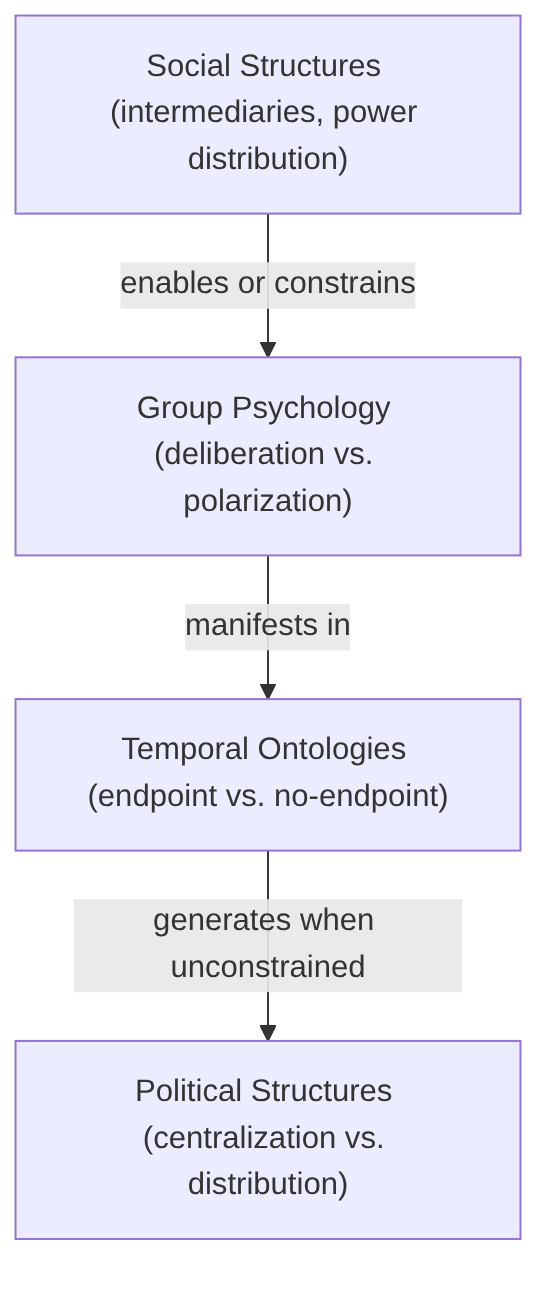
This book examines one level: temporal ontologies generating political structures.
A complete account requires examining all levels and their interactions.
But understanding each level distinctly clarifies what needs explaining. The temporal framework identifies systematic patterns requiring explanation. Structural and psychological theories explain why those patterns manifest or don’t in particular contexts.
2.6.5 Theoretical Honesty
Acknowledging what the framework doesn’t explain makes it more credible, not weaker.
Over-claiming invites justified skepticism. If a framework claims to explain everything, critics rightfully dismiss it as reductionist. If a framework claims temporal assumptions alone determine all political outcomes, counterexamples (like Nordic social democracy) appear to refute it entirely.
But if the framework claims: temporal assumptions generate systematic structural tendencies when applied consistently and unconstrained by robust institutions—then counterexamples become opportunities for nuance, not refutations.
Nordic doesn’t refute the framework. Nordic shows: endpoint-belief constrained by robust structures moderates significantly. This confirms the framework’s scope conditions while inviting structural theories to explain why Nordic developed constraining institutions.
Good theory specifies:
What it explains (logical tendencies within ideal types), What it doesn’t explain (structural differences, psychological drivers), When it applies (ideal-typical logic vs. mixed empirical reality), and What constrains it (structural conditions, cultural patterns).
This chapter has attempted that specificity.
Conclusion
This chapter established time as criterion for understanding political conflict.
Time assumptions are “more generative” than other foundational variables—human nature, scarcity, and power—because they structure responses to these variables rather than competing with them. From this generativity flows a single fundamental question that precedes all policy debates: Does history have an endpoint?
From that question flow two ontological stances. Endpoint-belief holds that history moves toward a knowable, achievable perfect state; no-endpoint commitment holds that society evolves perpetually without terminus. Each generates systematic implications across epistemology, ethics, institutions, and coordination. Same questions produce opposite answers depending on temporal ontology.
Temporal reasoning operates in political practice, not just theory. Revolutionary movements invoke endpoint-belief to justify transformation; conservative movements invoke no-endpoint commitment to defend continuity. Contemporary politics is saturated with temporal reasoning.
The framework acknowledges its scope: it explains logical tendencies within ideal types, not all empirical variation. Structural constraints, group psychology, and cultural patterns also matter profoundly.
The chapter made an analytical claim: temporal assumptions structure politics in systematic ways traditional criteria miss. It has not yet made normative claims. Whether endpoint-belief or no-endpoint commitment is preferable remains open.
Part II develops both logics in their pure forms, presenting each in its strongest version. Blueprint Type (Chapter 3) derives systematically from endpoint-belief. Principle Type (Chapter 4) derives systematically from no-endpoint commitment.
Only after both logics are fully developed—analytically, fairly, systematically—can normative evaluation proceed.
The framework is now established. The derivations begin.